

The Briefcase #54: The Secret History of Accounting Terms
Written by: AccountingCPD | Published: 7th Aug 2026 | Updated: 7th Aug 2026
Accountants have a lot of jargon in their lexicon. Terms like “month-end” might seem obvious to you, but to most of the population, it’s the thing that happens just before month-start.
But, as you’re no doubt well aware, the history of accounting is full of colour. Hidden behind everyday accounting terms are fantastical stories of medieval kingdoms, Renaissance merchants, Latin scholars, and centuries of international trade.
So, in this week’s Briefcase, let’s take a look at the origin of a few accounting terms, so that next time you’re in a finance meeting, you can start daydreaming about being a gallant knight or a Roman socialite.
Exchequer
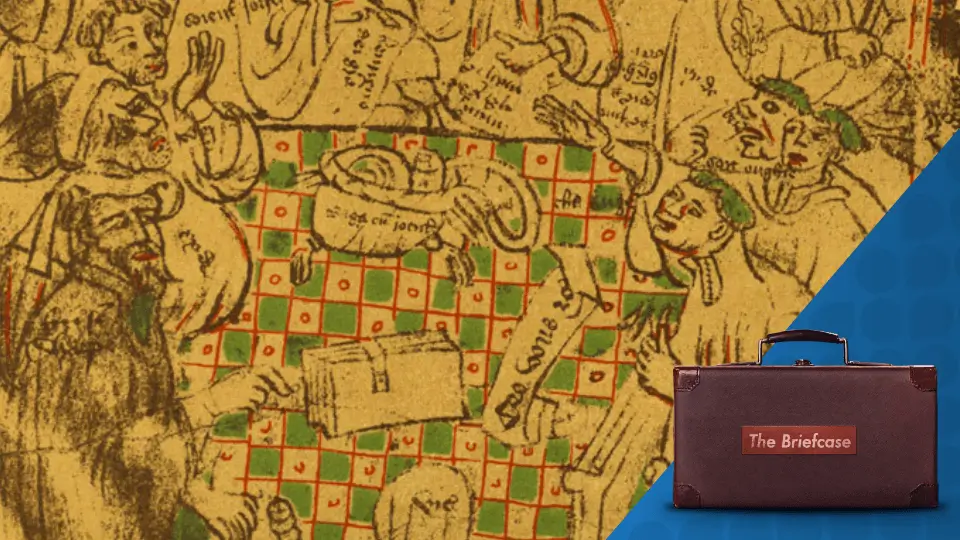
We’ll start with the United Kingdom’s most esteemed financial position – the Exchequer. The word comes from the Old French eschequier, meaning a chessboard or chequered cloth. If this doesn’t intuitively make perfect sense, we can spell it out for you.
In medieval England, royal officials gathered around a large black-and-white chequered tablecloth and used counters to calculate the King’s income and spending. Long before calculators – or even the widespread use of Arabic numerals – it served as a kind of giant accounting aid, rather like a medieval Excel spreadsheet. Someone could even start editing your work while you’re away from it, completely ruining the delicate tapestry you’d woven.
The institution eventually became known simply as the “exchequer”, which is why the UK’s finance minister is still called the Chancellor of the Exchequer nearly 900 years later.
John Healey is the new Chancellor of Exchequer, but sadly seems more interested in rating pub snacks than ushering in a return to tradition – he has made no sounds regarding using a big tablecloth to do all his important sums on.
Audit
Modern audits involve sampling, controls, risk assessments, and enough Excel spreadsheets to wear down the Ctrl, C and V buttons on your keyboard to nubs. The word itself, however, comes from the Latin audire, meaning “to hear.”
In medieval Europe, financial accounts were often read aloud – like a bedtime story, but far more effective at putting people to sleep. The auditor’s role was literally to listen to the accounts being presented, and question anything that sounded a bit weird.
Thankfully, today’s audit files contain rather more documentation, and a successful audit doesn’t rely on the man reading it to you being able to pronounce “proforma”. Still, every audit begins with the same basic principle it always has: does the evidence support what’s being presented?
Bankruptcy
Our next word takes us to medieval Italy – often considered the birthplace of modern accounting. The word “bank” comes from the Italian banca, meaning a bench or table. Much like duckfeeders, money changers carried out business from wooden benches. However, they did so in marketplaces where merchants exchanged currencies and arranged loans, instead of by a nice pond.
When one of those money changers failed, legend has it that local authorities would break the bench to show that the business could no longer operate. The Italian phrase banca rotta – literally “broken bench” – eventually became the English word “bankrupt”.
Modern insolvency procedures are considerably more sophisticated, although smashing a faulty printer might still feel like the natural thing to do.
Ledger
A ledger doesn’t sound like the sort of word with an exciting history. And, to be fair, it doesn’t, but we’ve started with this idea and we need to fill out a bit more space.
The word comes from Middle English, and originally referred to a book that lay permanently in one place, rather than travelling around with merchants or officials. It was the master record that stayed where everyone could find it.
That’s not the entire explanation though, as you might have realised, since it still doesn’t make sense. The other half is in the strange way that people in England used to speak. Instead of saying “laying”, they said “liggen” or “leggen”. So, the ledger was laying down in one place.
Today, of course, most ledgers don’t lie anywhere at all. In fact, they do the opposite, often flying through the cloud. But the idea remains exactly the same – one reliable record that everyone trusts.
Debit and credit
These two are inseparable, both in accounting and in history. Debit comes from the Latin debere, meaning “to owe.” Credit comes from credere, meaning “to believe” or “to trust.” It’s an elegant way to think about double-entry bookkeeping, among many elegant ways to think about double-entry bookkeeping.
Every transaction records both an obligation and the confidence that the records accurately reflect what has happened. At its core, like any specialism, accounting has always depended on trust. Which is why you can always be sure that the accountant isn’t the one not eating all the biscuits in the office.
Salary
Finally, a pub quiz mainstay. The word “salary” comes from the Latin salarium, and “sal” means “salt”. What on earth can those two things have in common, you ask? Surely there’s no way, you cry? Well, hold on, because there actually is a connection.
For centuries, salt was enormously valuable. It preserved food, which made it essential to everyday life, because back then they hadn’t invented fridges yet – a move which most historians agree was an oversight.
However, this is where it gets a bit murky. Famously, the explanation goes that Roman soldiers were paid in salt, which is fiercely contested. Now, it’s generally accepted that the two concepts are linked, but there’s no sources that say that salt was accepted as a form of payment.
Thankfully, it’s also not considered an acceptable payment today. That doesn’t mean it isn’t still good to be “worth your salt”.
🧠 Final thoughts
Accounting has changed beyond recognition over the last thousand years – we’ve replaced tally sticks with spreadsheets, chequered tablecloths with digital dashboards, and not salt with not salt. The words we hear, though, still have ancient roots.
So, the next time someone mentions the Exchequer, updates the ledger, or asks for an audit, you can transport to the olden days and, if you’re feeling adventurous, respond back in kind: “I doth thanke ye for your e-maile, it hath founde me welle and hale”.
Ready to power up your CPD?


Updated 7th Aug 2026 | 6 min read