

The Briefcase #57: Is John Healey an Economist? And Why Does Nobody Seem to Care?
Written by: AccountingCPD | Published: 27th Aug 2026 | Updated: 27th Aug 2026
A little while ago, AccountingCPD, amongst many others, asked a simple question: is Rachel Reeves an economist?
It became one of the most-read articles we’ve ever published, as thousands of people apparently developed an urgent need to establish exactly what qualified the Chancellor to be the Chancellor.
Britain now has a new Chancellor, John Healey. So, naturally, we’re returning to the well that provided us with so many of your lovely clicks. However, the issue is that no one seems to care about John Healey’s experience.
There has been plenty of discussion about what Healey will do at Number 11. But compared with the extraordinary interest in Reeves’ CV, no one seems to really care whether John Healey has relevant experience, or even what he did in his gap year.
In a valiant effort to drum up a media circus, we’re going to start asking that simple question.
Is John Healey an economist?
The short answer is no. At least, not by the conventional definition of someone academically or professionally trained as an economist.
Healey studied Social and Political Science at Christ’s College, Cambridge. Before entering Parliament, his career included journalism, disability-rights campaigning and working as campaigns director at the Trades Union Congress.
Healey first entered Parliament in 1997. He was Parliamentary Private Secretary to Gordon Brown when Brown was Chancellor, before becoming a Treasury minister himself. Since then, his ministerial CV has included housing, local government and, most recently, defence. He became Chancellor in July 2026.
So, John Healey isn’t an economist. But neither is he somebody who accidentally wandered into Number 11 while looking for the Ministry of Defence, which makes the comparison with his predecessor rather interesting.
How qualified is he compared with previous Chancellors?
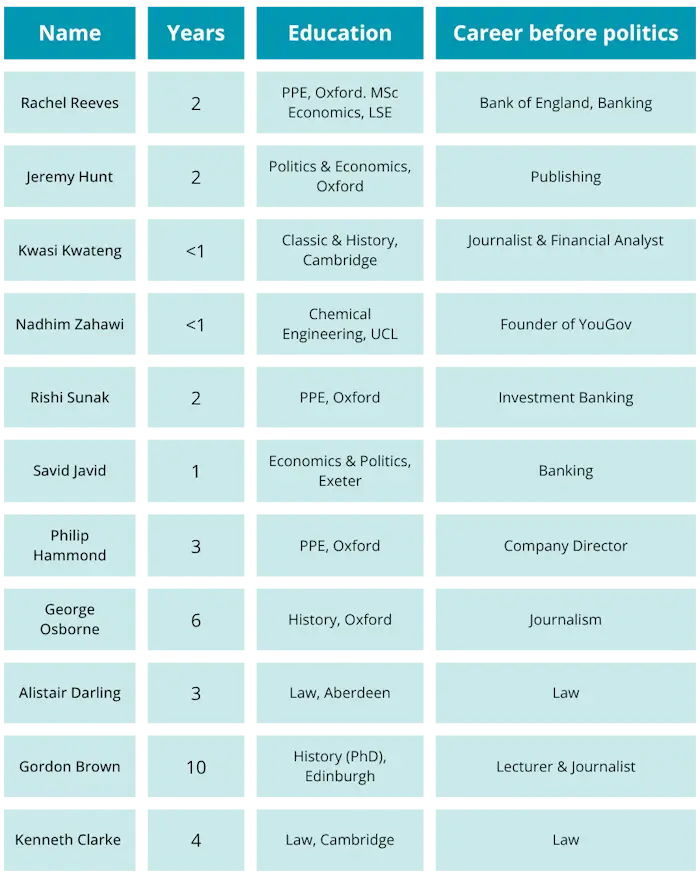
If Britain appointed Chancellors based purely on economics qualifications, Rachel Reeves should have been fairly difficult to beat.
She studied Philosophy, Politics and Economics at Oxford, completed a master’s degree in Economics at the London School of Economics and joined the Bank of England’s graduate scheme, where she worked as an economist. Or, in more economic terms, she was definitely an economist.
Healey, by comparison, has no economics degree, but British Chancellors have arrived at the Treasury from all sorts of academic backgrounds. Gordon Brown studied history, and George Osborne studied modern history. Now they’re both ancient history, but the point remains – the Chancellor isn’t really the country’s chief economist. They’re more in the business of balancing competing interests, like any other politician.
Does the Chancellor actually need to be an economist?
It certainly can’t hurt.
Understanding economics is quite useful when your responsibilities include fiscal policy, growth, productivity, capital markets, and representing the UK at institutions such as the IMF. At the very least, you’re less likely to hear “bond yields” and think about Pierce Brosnan surrendering to Sean Bean.
Healey brings decades of ministerial experience to the role, including previous experience inside the Treasury. Reeves arrived with much stronger formal economics credentials. But neither tells us who will be the better Chancellor.
It’s a little like senior roles in accountancy – you wouldn’t necessarily expect the CEO of an accounting firm to know more about every paragraph of IFRS than every technical specialist working underneath them. You would, however, hope they know which technical specialist to listen to.
Why did everyone care whether Rachel Reeves was an economist?
Well, Reeves’ economic background had formed an important part of her political identity. Questions subsequently emerged about how parts of her career had been presented – including the length of time she worked at the Bank of England and descriptions of her subsequent role at HBOS. Her LinkedIn description of the latter was changed from “Economist” to “Retail Banking”. This is a particularly amusing wrinkle – why do you have a LinkedIn? You’ve reached the top! It’s like Edmund Hillary having a LinkedIn, or Alexander the Great.
But if a politician makes their professional experience part of the case for putting them in charge of the country’s finances, journalists are entitled to check it.
However, it’s fair to say that some of the snippiness was tinged with prejudice. A lot of commentators questioned whether a male Chancellor would have attracted the same sort of condescending label, especially given that so many in the past had no real economic background at all. And if a new precedent was being set – that a Chancellor must also be an economist – it hasn’t stuck around to haunt John Healey.
Why should I care?
You should care generally but, to look inwards, it’s not as if the accountancy industry has been plain sailing for women. Women in accountancy spent a remarkably long time being asked, in one form or another, whether they really belonged there. One of our favourite examples is Mary Harris Smith.
Smith established her own accountancy practice in London in 1887. She spent decades working as an accountant and repeatedly attempted to join the professional bodies that represented her profession. Every time, she was refused for explicitly sexist reasons.
After a long battle, the Sex Disqualification (Removal) Act 1919 finally began dismantling the legal barriers preventing women from entering the profession and, in 1920, Smith became the first female Chartered Accountant admitted by ICAEW.
Rachel Reeves being called “Rachel from Accounts” is obviously not the same as women being legally excluded from the accountancy profession, but the derision is part of the same history.
Historically, women entering male-dominated professions – or, indeed, any job – have had to work especially hard to gain the same respect as their male contemporaries do. Which isn’t funny, but it is true.
🧠 Final thoughts
So, is John Healey an economist? No. Does that mean he’s unqualified to be Chancellor? Not necessarily. Perhaps the question isn’t why nobody seems particularly bothered that John Healey isn’t an economist, it’s why we were so bothered about whether Rachel Reeves was one. Even if you don’t particularly like her, and even if you think she hammed up the experience too hard, it’s still possible to see it as a mess not entirely of her own making.
And, gazing back over history, like so many of our former Chancellors have done, it’s fair to say that luck plays quite a big role. For all the bombastic Budgets, Chancellors also inherit economies, interest rates, and wars. Even the most critical observer wouldn’t argue that Rachel Reeves blocked the Strait of Hormuz.
So, perhaps the best qualification for becoming Chancellor is being lucky enough to get the job at the right moment. On that basis, good luck, John Healey, you’re going to need it.
💡 Want to learn more about economics?
Our 4-hour CPD course Economics Every Accountant Should Know focuses on how accountants can use economic concepts to underpin pricing strategies and investment decisions, to create market and product strategies and to strengthen and better understand relationships with customers..

Ready to power up your CPD?


Updated 27th Aug 2026 | 6 min read