

The Briefcase #49: The Accountant’s Guide to Critical Thinking
Written by: AccountingCPD | Published: 3rd Jul 2026 | Updated: 30th Jul 2026
Nobody wakes up in the morning and thinks, “today, I shall make several incoherent decisions based on half-understood information, personal bias and a complete disregard for anyone else’s input.” But here we are, with people seemingly getting out of bed in that exact frame of mind.
When all you need is a strapline like “powered by AI!” to hoover up a load of greedy investors, it’s no surprise that hunks of plastic are being released everyday that “solve problems” that 0.0001% of the world feel hounded by. If you’re frustrated that your fridge doesn’t connect to your TV, you’re living in the right century.
But that doesn’t mean that critical thinking doesn’t matter any more. In many ways, it matters more than it ever has done. Software can do the drudgery, but your accounting mind can do so much more. The challenge isn’t gathering data, it’s figuring out whether it’s any good.
🧠 Your silly brain
Unfortunately, the biggest threat to good decision-making is sitting between our own ears. The human brain is remarkable – it will routinely bring up the first time you had your heart broken when you’re trying to relax in the bath, but it’ll imagine a new place for your phone when you get out.
This is partly because your brain loves shortcuts. Once we’ve formed an opinion, we naturally look for evidence that supports it. If you’ve ever accidentally argued with someone on the internet, you’ll realise that 99% of people would rather walk out in traffic than admit that they’re wrong.
But if we’re conscious of this, we can start doing something about it. If we recognise ourselves as potential victims of anchoring bias, we can deliberately consider other viewpoints, no matter how obviously wrong and insane they are.
🔍 Peeking behind the curtain
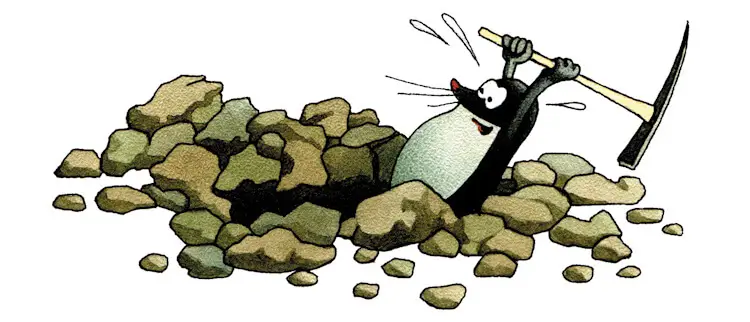
One of the most useful critical thinking skills is learning to dig beneath the surface. For example, a client says profits are falling. That’s useful information, but it isn’t an explanation.
You need to ask “why?” Then ask why again, and again, and again – a bit like an annoying child who, for some reason, isn’t satisfied with the answer “just ‘cause, now eat your peas or they’ll be no Rockford Files for you.”
Eventually you get beyond symptoms and start finding causes. It’s a bit like pulling weeds – if you only remove the visible part, the problem comes back. You need some good old elbow grease to pull out the roots.
The same applies in business. Cashflow problems might actually be pricing problems, pricing problems might actually be sales problems, sales problems might actually be customer service problems, and so on and so forth. The first answer is often just the beginning of the story, and what a yarn you might tell.
🤖 The rise of AI
When AI first exploded into public consciousness, there was a lot of talk about it replacing professional judgement. If a machine could instantly answer complex questions, what would be left for accountants to do?
Well, AI doesn’t really think in the way people do. It identifies patterns, predicts likely responses, and assembles information based on what it has seen before. That can prove useful, especially in a pinch, but AI can’t make a judgement. It doesn’t possess experience, and it hasn’t got a digestive system so it can’t feel that famous feeling in its gut.
The role of the accountant is gradually shifting as a result. 20 years ago, much of the focus was on checking calculations and processing information. Increasingly, the challenge is evaluating assumptions. In other words, it’s about deciding whether the answer deserves to be trusted, and that’s a distinctly human skill.
Maybe the stereotype of the accountant will gradually shift away, too, and everyone will think you’re extremely cool soon.
🔄 Taking a moment
The ability to reflect, honestly and sincerely, is a powerful critical thinking skill.
Busy professionals spend most of their time moving forward – meeting deadlines, answering emails, and shoving an entire blueberry muffin in their mouth 10 seconds before a video call starts. So, it’s no wonder that taking a moment to think about the day’s decisions can separate you from the pack.
A difficult client conversation, a failed project, or a decision that didn’t work out can all teach you something if you’re willing to examine them honestly. That isn’t necessarily easy, and it can take a bit of practice before you start feeling it.
The trick is not to rewrite history in your own favour. Often, the instinct is to blame some other unwitting fool, or some glitch in the system, but there’s often a deeper reality to it all. Critical reflection means asking what actually happened, why it happened, and what you would do differently next time.
It isn’t always comfortable. But neither is making the same mistake twice.

🧠 Final thoughts
Critical thinking isn’t about being the smartest person in the room, even though you obviously are. Realistically, anyone can be a critical thinker. They just need to be willing to question assumptions, challenge easy answers, and occasionally admit that what they initially wanted to do was quite stupid.
That’s becoming increasingly important in a profession where AI can produce answers in seconds. If you’re unable to utilise professional judgement, you might as well be ChatGPT, splurging out the first thing that you can draw on.
So, with this in mind, take a moment to slow down, think about your day, and eat a blueberry muffin in two minutes. That way, you’ll really savour it.
💡 Want to learn more about critical thinking as an accountant?
Our Critical Thinking for Accountants course explores practical techniques to help you question assumptions, analyse information and make better professional judgements.

Ready to power up your CPD?


Updated 30th Jul 2026 | 5 min read