


The Briefcase #65: Which Profession Does The Most CPD?
Written by: AccountingCPD | Published: 6th Nov 2026 | Updated: 6th Nov 2026
Accountants are used to continuing professional development. Staying current is part of being a professional – particularly when standards, regulations, and the technology we work with changes so regularly it’s enough to make you carsick.
But the suffering isn’t confined to accountancy. Doctors do CPD, nurses do it, lawyers do it – loads of people do it. Basically, if your job is at all important, you need to do it. If you don’t have to do CPD, firstly, why are you reading this? And secondly, sorry to be the bearer of bad news, but society would probably rumble on without you.
However, each profession approaches CPD differently. In the interests of getting involved in stuff that isn’t really any of our business, we decided to have a look at what these approaches entail.
We’re keeping things mainly to the UK, because once you start comparing different countries the whole exercise becomes considerably less manageable. In the US alone, professional requirements can vary by state, and including all of that is way too much work for a bloggy thing that we bash out in an hour every week.
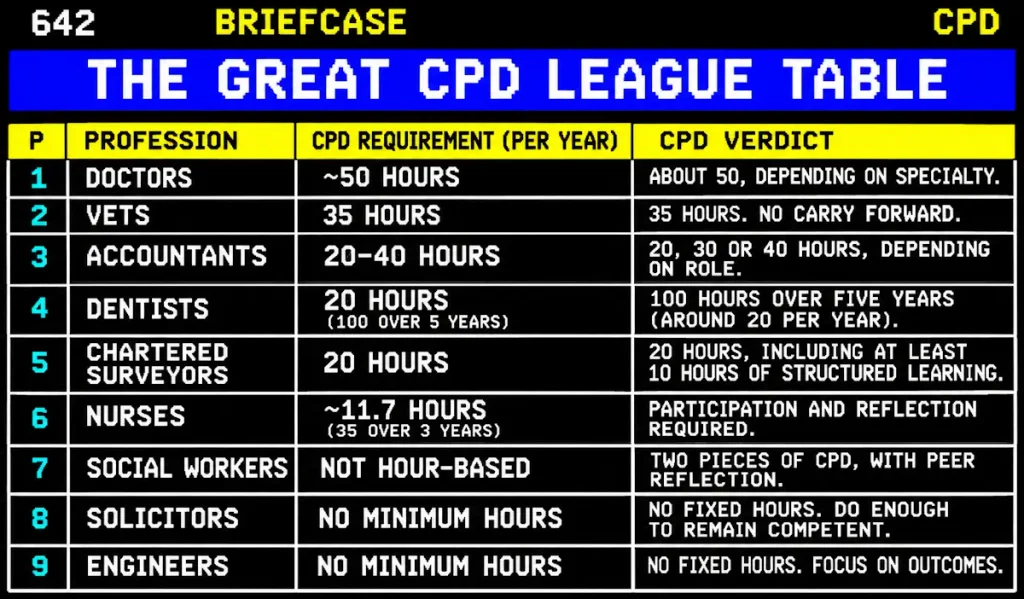
To keep this limited, we’re looking at annual requirements, how learning is recorded and the different ways professions demonstrate that they are continuing to develop. This is not, in any meaningful sense, a scientific methodology. It does, however, have a league table.
📊 Accountants
You probably know all this already, but let’s get it in writing before we crack on with all those less important jobs like nurses and doctors.
Under ICAEW’s current rules, members in scope generally fall into categories requiring 20, 30 or 40 hours of CPD each year, depending on their role, with part of that learning needing to be verifiable. ACCA takes a slightly different approach, using 40 units of relevant CPD each year, with at least 21 units verifiable. One unit is broadly equivalent to one hour.
So, even within accountancy, there isn’t one universal answer to “how much CPD does an accountant do?” Some do more, some do less, but all are greeted with the same enthusiasm when they explain what they do at a party.
League form: Strong.
🩺 Nurses
Nurses and midwives registered with the UK’s NMC need 35 hours of CPD over three years, at least 20 of which must involve participatory learning. They also need to keep records and evidence of what they’ve done. The wider revalidation process goes further, with practice-related feedback, written reflective accounts and a reflective discussion all forming part of the picture.
So, nurses may have fewer formal CPD hours than some accountants, but their wider revalidation requirements bring considerably more reflection and professional interaction into the process. No hunkering over a laptop for them!
League form: Reflective.
⚖️ Solicitors
Solicitors regulated by the SRA have no minimum CPD hours requirement. Instead, they’re expected to “reflect” on their work, identify any learning and development needs and undertake whatever development is necessary to remain competent.
This is obviously extremely vague. Presumably, the type of person to take these requirements seriously would be the type of person who would be doing them anyway. Could you argue that you’re “reflecting” on your work when you are complaining about your annoying co-worker? We say that you could.
League form: Resolutely unquantified.
🦷 Dentists
Dentists need 100 hours of verifiable CPD over a five-year cycle. They also work with a personal development plan and record their learning. An accountant will immediately divide 100 by five and announce that this is 20 hours a year. Well done, accountant, you’re very good at dividing.
But, as any CPD provider can tell you, all of those hours will take place in the December of year five.
League form: Surprisingly familiar.
🩻 Doctors
The GMC requires doctors to undertake CPD every year, but doesn’t prescribe a particular number of CPD points for revalidation. The learning should cover the doctor’s whole scope of practice, and reflection is an important part of the process. A bit solicitory, then.
Individual Royal Colleges and specialty bodies can be rather more numerical. The Royal College of Surgeons, for example, says surgeons should complete 50 hours of CPD each year, while the Federation of Royal Colleges of Physicians recommends an average of 50 credits a year, or 250 over a five-year cycle.
Leaving the entire matter at “use your professional judgement” feels slightly adventurous for people whose working day will inevitably involve matters of life and death. We would advise asking your doctor which professional body they are registered with before receiving treatment.
League form: About 50 hours, depending on specialty.
🐕 Vets
Veterinary surgeons registered with the Royal College of Veterinary Surgeons (RCVS) need 35 hours of CPD every year, and they are expected to reflect on what they have learned as part of the process. Obviously, the immediate thought is that the vet treating your Labrador has completed more CPD this year than the person prescribing you statins.
Vets have entered the competition with a steely determination, which is no surprise for a profession who regularly “put down” beloved family pets.
League form: 35 hours, firmly on the board.
📐 Chartered surveyors
RICS members need at least 20 hours each year, including at least 10 hours of structured learning. The 2026 framework also includes planning and reflection, alongside mandatory topics that rotate across ethics, sustainability, and data, AI and technology.
This feels comfortingly close to accountancy. If accountants ever need someone to sit with at the professional-development Christmas party, we have found them. They can probably talk about how exciting their jobs are.
League form: Accounting adjacent.
👥 Social workers
Social workers in England must record at least two different pieces of CPD each registration year, with peer reflection included in at least one of them.
Before accountants begin drafting angry letters to their professional bodies, remember that the emphasis is on reflection and explaining the effect on practice rather than accumulating hours. It’s also perhaps worth noting that social workers get paid very little and are often in actually dangerous situations, so would maybe not kick up too much of a fuss.
But two pieces of CPD? Come on now.
League form: Low volume, high reflection.
⚙️ Engineers
For professionally registered engineers and technicians under the Engineering Council framework, there is no specified minimum number of CPD hours. Instead, registrants are expected to plan development, undertake appropriate activities, record them, reflect on what they’ve learned and evaluate the results.
This is the third profession we’ve encountered that has refused to provide us with a nice, easy number. We would have expected better from people who work with measurements.
League form: Unquantifiable.
🧠 Final thoughts
The main thing this entirely unofficial competition proves is that there is no single way to do CPD. In fact, there are such a variety of ways to perform CPD that you might be excused for assuming that some of them are actually less requirements and more suggestions.
Accountants are working with pretty well-defined guidelines, all things considered. If, perhaps, we had realised that not every professional body works within the same general guidelines before we started this endeavour, then maybe we wouldn’t have bothered. But, as we said, we try to spend as little time on this as possible, so here we are.
However, we did mock up a league table. You’re third – enjoy the bronze.
Ready to power up your CPD?


Updated 6th Nov 2026 | 7 min read