

Artificial Intelligence
Imagine an accountant who never sleeps, never makes mistakes, and tirelessly processes mountains of data in seconds. This is the power of artificial intelligence and, beyond mere automation, it is beginning to reshape how accountants strategise, predict, and advise. Are you ready?
£500 +VAT
AI is transforming our world. In many areas, the accounting sector is already embracing it. But how else is it going to affect what we do, and what challenges does that bring?
This pathway prepares you for the AI road ahead. It looks at where we are now and what is around the corner. How are you going to integrate AI into your accounting function? What is generative AI and how is it going to help you? And, perhaps most importantly how to manage the risks, governance and ethical challenges that we will face?
Those who embrace AI and understand how to deal with the challenges, will be an essential asset to their organisations to help drive growth in business, provide new services for clients and build a sustainable financial future.
The pathway takes into account and demystifies the vast array of research conducted in this area and gives you the skills highlighted as necessary in these reports. It draws on reports including:
- ACCA’s report, The Smart Alliance: Accounting expertise meets machine intelligence
- ICAEW’s Artificial intelligence and the future of accountancy
- ACCA’s “AI in the Finance Profession” which emphasises that effective accountability requires a level of AI literacy
- A study from EY that found that almost 75% of finance leaders surveyed believed that AI will positively impact the accounting and finance sector
- The “Going for Growth: Creating an AI-first Future in Accounting” report created by ACCA and leading think-tank Demos, that reveals that 63% of accountants and bookkeepers are worried that skill gaps will restrict their effective use of AI

In this pathway

Learning
Supporting your journey to the next stage of your career

AI skills
The tools, techniques, and skills you need to use AI effectively and ethically as a finance professional

Flexibility
Learn where you want, when you want

Certificate
21 verifiable hours of CPD, an assessment and a Certificate of Achievement
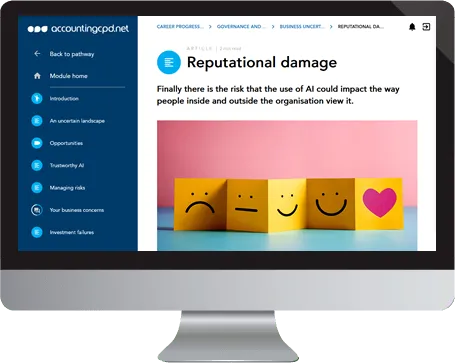
Learning resources
Immerse yourself in the rich variety of articles, videos, activities, quizzes, discussions, and more.
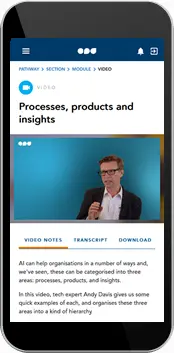
Expert interviews
Find out what real finance professionals think about the potential benefits and issues involved in using AI in accounting, from governance, risk management and ethical considerations, to practical applications that will support and develop organisations.

Action plan
Build up a practical plan of how you will put your new skills into action, and download a convenient summary of all the learning to take away.
Assessment
Achieving 75% on the multiple choice assessment is required to complete the career progression pathway. The assessment features two questions on each topic that has been covered.

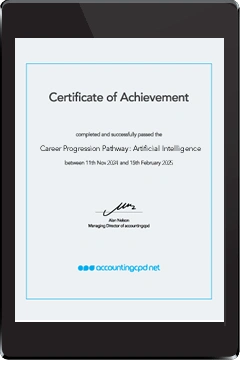
Secure certification
Once you’ve finished the programme, you will receive a unique and secure Certificate of Achievement as evidence of your new understanding and capabilities.
This Career Progression Pathway is divided into four sections corresponding to the key skills you will need to develop to become an effective trusted advisor. Complete all four to unlock the end of pathway assessment and access your Certificate of Achievement.
AI and accounting
Imagine an accountant who never sleeps, never makes mistakes, and tirelessly processes mountains of data in seconds. This is the power of AI and it is beginning to reshape how accountants strategise, predict, and advise.
- Importance of AI
- Automation
- AI and audit
- Preparing for the future
Governance and risk management
Well-developed AI systems should always be under the control of humans and prevented from doing harm. However, current controls are not always effective, so there is work for organisations to do in the essential areas of risk and governance.
- Exploring AI technology
- Governance framework
- Business uncertainties
- Managing AI risks
Ethical considerations for accountants
How do we ensure AI operates fairly, transparently, and in alignment with professional accounting standards? We must harness AI’s power responsibly while upholding the integrity and trust central to our profession.
- Ethics of AI
- Using AI ethically
- Fit for purpose AI
- Hybrid intelligence
Generative AI
Generative AI is a groundbreaking technology that’s reshaping how we approach accounting. We must equip ourselves with the skills to harness these tools, transforming traditional accounting into a dynamic, forward-thinking profession.
- Exploring generative AI
- Strengths and limitations
- Generative AI at work
- Adopting generative AI
Integrating AI into the finance function
Integrating AI into the finance function or your firm is necessary to effectively and safely harness the opportunities that these new tools offer. This final section offers practical advice and strategies.
- Impact of AI on the sector
- AI applications in finance
- AI and your finance function
- Future trends and innovations
Assessment
Once you have completed all the elements of the pathway, you can take the assessment to access your Certificate of Achievement.
Lead Consultant

Andy Davis
Andy Davis is a writer on investment, finance and business. He spent 15 years as a journalist on the Financial Times where he held a series of senior roles including editor of FT Weekend. Andy writes for a range of financial publications and is a columnist for Review. He has been named Personal Financial Journalist of the year in the Wincott Awards.
Andy has been researching and writing about machine learning for his corporate clients for several years now, particularly in areas such as fraud detection and data analysis applications in banking and asset management. And as a specialist writer on financial services and fintech, he naturally takes a close interest in the development of generative AI and its business use cases – particularly editorial content production.
Other contributing faculty

Alan Nelson
Alan Nelson is the Founder and Managing Director of accountingcpd. He presents accountingcpd’s webinars, is the face of its You Tube channel, and the resident expert on management and leadership in the accountancy profession. He has been Chair of ICAEW’s Practice Assurance Committee, and a member of ACCA’s SME Committee and of IFA’s Regulatory Committee. He is currently a member of the Bank of England’s Decision Making Panel.

Jeremy Swinfen Green
Jeremy Swinfen Green is a director at Obidos Consulting, a digital strategy, transformation, and innovation agency. With over 25 years of experience, he has advised both public and private organisations on the effective, safe, and responsible use of digital technology. Jeremy also serves as a committee member of the BSI’s ART/1 artificial intelligence committee.

Julia Penny
Julia Penny is the Immediate Past President of ICAEW, having been a non-executive ICAEW Board member since 2017 and Chair of the Board during her year as President. Julia is a well-known speaker and writer on audit, financial reporting, anti-money laundering and wider issues impacting the profession.

Marie Speakman
Marie Speakman has over 30 years experience spanning roles from credit controller to European CFO, and having built her own accountancy practice, Marie is now focused on helping finance professionals embrace AI solutions. Marie’s journey into AI started in 2020 when she collaborated with experts to integrate AI into debt collection processes while maintaining regulatory compliance. Today, she partners with businesses to streamline operations and unlock growth through AI.
Xinyu Chen –
very inspiring
Nilan Fonseka –
It was excellent. But would have liked more examples how if everything works. More case studies.
Gurdeep Singh –
Very informative and good amount of topics covered to bring you up to speed about current developments in the world of AI!
Tim Anklesaria –
Good course to give you an overview of what AI is, what it is capable of and the main things you need to factor in when looking at how to bring AI into the finance function. Also gave some insight into upcoming tools. I would have liked some more detail on available tools and how to use them effectively, but I will acknowledge that is very dependent on the type of work you are doing and the ways you may be looking at to integrate AI.
Paul Whyte –
easy to follow, detailed information, challenging questions and assessment to check understanding
Fiona Harrison –
Really enjoyed the course. Heavy going in places but its a long time since I did any organised learning like this
Andy Phillips –
My knowledge of AI has come on leaps and bounds from this course, from understanding how it can be used now to where the developments are heading, as well as the issues involved for creating a successful AI project to be introduced into an accounting function.
Brian McCormick –
Really interesting subject, I liked the focus of the course where it concentrated on many ethical and governance issues with AI, rather than the mechanics of how to get the best out of AI. This is an important element and is definitely one that I will take back to my workplace. AI is being rolled out but the guidance with the caveats highlighted in the course are not being made clear to the staff, so this has definitely opened my eyes to the bigger strategic picture of AI, it’s not just about typing a question into an AI tool and a comprehensive answer appears. Take it with a pinch of salt.
Tristan Loftus –
As someone who paid for this course, as a way to upskill between jobs, This course is a perfect introduction and explainer to the world of AI. Within this 25 module course is enough information to educate people on the history of AI, types of IA and their specific applications in the real world (rather than having people say “AI will fix everything”). The course also addresses many of the concerns people have with AI and provides useful guidance and suggestions on how to best prepare and protect your organisation from common AI pitfalls. As an Internal auditor, I feel significantly more prepared to not only advise on the development of AI projects, but am excited at the prospect of reviewing and advising clients on how to strengthen their AI environment. Would definitely recommend!
Olessya Gelyuta –
Training was good. Thank you! In assessment could you do the option immediatly see whether chosen ansver is correct or not? That will be helpful.
Alan McCartin –
Very comprehensive and thought-provoking. A useful guide to work application.
Perry Vogel –
Theres alot of content that is repeated and a bit fluffy. Would have like to see this condensed down to remove repetitive information. Overall its got a fair amount of information, but I dont feel ive walked away with a huge amount of learning.
Yang Li –
This is a very interesting topic and has given me a better understanding of how AI will affect the accounting industry.
Pieter Robbertze –
Easy navigation, good information
Omer Sultan –
A new way look at adding AI to accounting
Stephen Sotra –
.
Vonchaz Lum York –
It was very informative and necessary given the way the world is transitioning towards Artificial intelligence.
Valentin Lomadze –
Great!
Arman Toleuov –
Very comprehensive training. Very informative
Marie Doherty –
it was good to build my awareness of AI possibilities and how they would apply to my role. The consideration of ethical matters was eye-opening. Some modules were too technical for my needs though and I found it a struggle to keep my attention on them. I feel much better equipped to have Board-level, strategic discussions about AI and how we may implement some functions in the accounting team. The roadmaps to roll out were really helpful and tips on the people side very good.
Matthew Wilkinson –
Anthony Fenlon –
Very good.
Anish kumar Kheddoo –
Very specifically explained with regards to the impact on Finance.